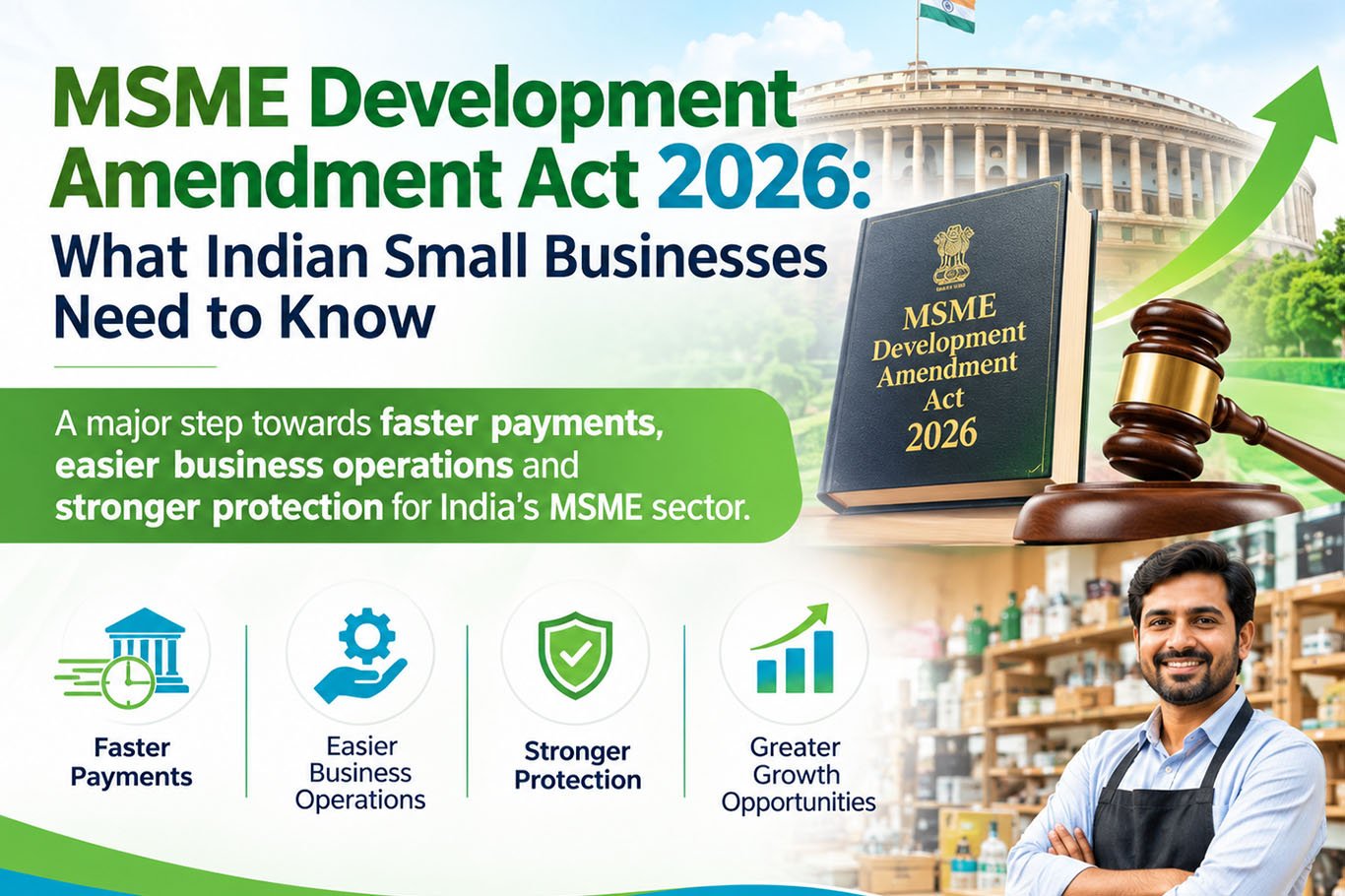
MSME Development Amendment Act 2026: What Indian Small Businesses Need to Know
A major step towards faster payments, easier business operations and stronger protection for India’s MSME sector
India’s Micro, Small and Medium Enterprises (MSMEs) play a crucial role in the country’s economic development. From small manufacturing units and technology startups to service providers, traders and export-oriented businesses, MSMEs contribute significantly to employment generation, industrial development and international trade.
Recognising the changing needs of this sector, the Government of India has introduced the Micro, Small and Medium Enterprises Development (Amendment) Act, 2026, bringing important changes to the existing MSMED Act, 2006.
The amendment aims to strengthen the legal framework governing MSMEs, address delayed payments, improve dispute resolution mechanisms, simplify compliance and create a more supportive environment for business growth.
For business owners, entrepreneurs and MSME operators, understanding these changes is important for making informed business decisions.
1. Why Was the MSME Development Amendment Act 2026 Introduced?
The original MSMED Act was introduced in 2006. Over the last two decades, India’s business environment has changed considerably.
Businesses are increasingly adopting digital technologies, participating in international supply chains and operating through more complex financial and commercial arrangements.
However, several challenges continue to affect MSMEs:
- Delayed payments from customers and large organisations.
- Limited access to working capital.
- Lengthy legal procedures for recovering outstanding payments.
- Compliance-related difficulties.
- Limited financial resources for business expansion.
- Challenges in competing with larger organisations.
Delayed payments, in particular, have become a serious concern for micro and small enterprises. Even profitable businesses can experience financial difficulties when customers fail to settle invoices on time.
The 2026 amendment seeks to address these challenges by strengthening institutional mechanisms and improving the legal framework for MSME development.
2. Key Changes Introduced by the Amendment Act
A. Permanent Digital and Voluntary MSME Registration
The amendment provides for a national digital platform for MSME registration through a free and voluntary registration system.
The Udyam Registration Portal is recognised as an important digital platform for MSME registration.
This approach aims to simplify the registration process and encourage more businesses to become part of the formal MSME ecosystem.
What this means for businesses:
- Simplified digital registration.
- Reduced administrative burden.
- Better integration with government support mechanisms.
- Improved access to formal business opportunities.
Businesses should ensure that their registration details and classification are accurate and updated.
B. Stronger Protection Against Delayed Payments
One of the most significant aspects of the amendment is its focus on delayed payments.
Delayed payments create serious cash-flow problems, particularly for micro and small enterprises that depend on regular collections to manage salaries, purchases, operational expenses and loan repayments.
The amendment strengthens the existing payment dispute resolution framework.
It also provides for better recovery mechanisms for eligible mediated settlements and arbitral awards.
Why this matters:
A business should not have to struggle financially because a customer or large organisation fails to honour its payment commitments.
The amendment seeks to create a stronger legal environment for recovering legitimate business dues.
C. Mandatory TReDS-Based Invoice Settlement for Central Public Sector Enterprises
The amendment introduces an important provision requiring Central Public Sector Enterprises (CPSEs) to settle invoices relating to procurement from MSMEs through the Trade Receivables Discounting System (TReDS).
TReDS is a digital financing platform that helps MSMEs obtain funds against their approved trade invoices.
It connects MSME suppliers, corporate buyers and financial institutions.
Benefits for MSMEs include:
- Improved access to invoice financing.
- Better working capital management.
- Reduced dependency on conventional borrowing.
- Greater visibility of outstanding invoices.
- Opportunities to improve cash-flow planning.
The amendment also empowers the Central and State Governments to extend similar arrangements to other public-sector entities and authorities.
D. Faster Resolution of Payment Disputes
The amendment introduces specific timelines for mediation and arbitration under the MSME payment dispute resolution framework.
The key proposed timelines include:
- Mediation must be completed within 90 days from the date fixed for the first appearance.
- If mediation fails, the matter must be referred for arbitration within 30 days.
- The arbitral award must be made within 90 days from completion of pleadings.
These provisions aim to reduce prolonged disputes and help eligible MSME suppliers obtain quicker decisions.
E. Better Financial Protection During Pending Court Cases
The amendment also introduces stronger provisions relating to challenges against mediated settlements and arbitral awards.
Under the specified circumstances, courts can direct payment of a reasonable portion of the deposited amount to the MSME supplier while proceedings are pending.
Where an application to set aside an award, decree or order remains pending for more than six months, the amendment provides for payment of at least 50% of the awarded amount to the MSME supplier.
This is an important step towards reducing the financial pressure faced by smaller businesses during prolonged legal proceedings.
F. Easier Recovery of Outstanding Dues
Another important provision concerns the recovery of mediated settlement agreements and arbitral awards.
The amendment provides for eligible settlements and awards to be recovered as arrears of land revenue.
This strengthens the enforcement mechanism and aims to make the recovery of legitimate outstanding dues more effective.
G. Decriminalisation and Simplification of Compliance
The amendment also seeks to reduce unnecessary criminal penalties for certain procedural and compliance-related violations.
It introduces a graded penalty framework, including warnings for certain first-time contraventions.
The objective is to encourage compliance while reducing the fear of disproportionate penalties for procedural mistakes.
This is particularly relevant for smaller businesses that may not have dedicated legal and compliance departments.
3. When Do the New Provisions Become Effective?
An important point for business owners is that the Amendment Act does not bring every provision into force on the same date.
The Act received Presidential assent on 13 August 2026, and commencement has been notified in phases.
The commencement notification provides for:
- 15 October 2026: Sections 2–7, 11 and 13–17 came into force.
- 15 December 2026: Section 12 is scheduled to come into force.
- Sections 8–10, relating to important delayed-payment dispute resolution and enforcement changes, had not been assigned a commencement date under the notification as of 22 November 2026.
Therefore, businesses should distinguish between provisions already in force and provisions that have been enacted but are awaiting commencement.
The applicable government notifications and rules should be checked before relying on a particular provision in a legal or commercial dispute.
4. How Will the Amendment Benefit Different Types of MSMEs?
The impact of these changes will vary depending on the nature and size of the business.
Manufacturing Businesses
Manufacturers frequently supply products to large companies, government departments and public-sector organisations.
Better invoice settlement mechanisms and improved access to invoice financing can help manufacturers manage working capital more efficiently.
IT and Software Companies
Software development companies, IT service providers and technology startups often work on projects with milestone-based payments.
Improved payment dispute mechanisms can help eligible micro and small enterprises protect their financial interests.
Trading and Distribution Businesses
Traders and distributors often operate with narrow margins and depend on timely collections.
Better access to invoice financing and stronger recovery mechanisms can help them maintain business continuity.
Service Providers and Consultants
Consultants, agencies and professional service providers frequently face payment delays after completing assignments.
The amendment provides a stronger institutional framework for eligible micro and small enterprises to address payment disputes.
Export-Oriented MSMEs
Export businesses can benefit from stronger formalisation, improved financial management and better integration with digital financial systems.
However, export-related opportunities will also depend on trade regulations, financing availability and international market conditions.
5. What Should MSME Business Owners Do Now?
The amendment presents an opportunity for businesses to review their existing financial and operational practices.
Here are some practical steps MSME owners should consider:
- Verify Udyam Registration: Ensure that your business has valid and accurate Udyam registration details.
- Review MSME Classification: Check whether your enterprise meets the applicable investment and turnover criteria.
- Maintain Proper Invoices: Ensure that invoices, purchase orders, delivery records and payment acknowledgements are properly maintained.
- Monitor Outstanding Payments: Maintain a systematic record of pending invoices and overdue customer payments.
- Explore TReDS: Understand how invoice discounting can support your working capital requirements and check the eligibility requirements.
- Strengthen Financial Management: Maintain proper accounting records, cash-flow statements and financial reports.
- Understand Legal Rights: Consult a qualified professional when dealing with delayed payments, contractual disputes or recovery proceedings.
- Adopt Digital Business Systems: Consider ERP, CRM, accounting and inventory management solutions to improve operational efficiency.
6. The Role of Technology in the Future of MSMEs
While legal and policy reforms are important, technology will play an equally significant role in helping MSMEs become competitive.
Many small businesses still depend on spreadsheets, manual records and disconnected software systems to manage their operations.
As businesses grow, these practices can lead to inefficiencies, reporting difficulties and poor financial visibility.
Digital transformation can help MSMEs address these challenges.
Some important technology solutions include:
- ERP systems for integrated business management.
- CRM platforms for customer and sales management.
- HRMS for employee and payroll administration.
- Inventory management for stock control.
- Accounting automation for financial management.
- AI-powered reporting and business intelligence.
- Digital workflow automation for reducing manual processes.
Adopting suitable technology does not necessarily require a large investment. MSMEs can begin with affordable, scalable solutions based on their operational requirements.
7. What Does This Mean for Kerala’s MSME Ecosystem?
Kerala has a diverse MSME ecosystem covering manufacturing, food processing, IT services, tourism, healthcare, traditional industries, trading and professional services.
For businesses across Thiruvananthapuram, Kochi, Kozhikode, Thrissur and other industrial centres, the amendment presents an opportunity to strengthen financial discipline and improve business operations.
There is also considerable scope for industry associations, cooperative institutions, financial organisations and technology companies to support MSME development.
Some priority areas for Kerala include:
- Encouraging more businesses to complete Udyam registration.
- Promoting digital accounting and business management.
- Improving awareness of TReDS and invoice financing.
- Facilitating business-to-business networking.
- Supporting MSME exports and international partnerships.
- Encouraging technology adoption among traditional industries.
- Organising awareness programmes on government schemes and legal rights.
Industry associations can play an important role by helping their members understand new regulations and access relevant government support programmes.
Conclusion: A Stronger Foundation for India’s MSME Growth
The MSME Development Amendment Act, 2026, represents an important update to India’s MSME regulatory framework after two decades.
Its focus on delayed payments, digital registration, invoice financing, dispute resolution and simplified compliance addresses several long-standing concerns of smaller businesses.
However, the real success of these reforms will depend on effective implementation, awareness among entrepreneurs and accessibility of the supporting institutional mechanisms.
For MSMEs, this is the right time to review business practices, improve financial management, embrace digital transformation and prepare for the next stage of growth.
A stronger MSME sector means stronger businesses, more employment opportunities and a more competitive Indian economy.
About the Author
This article is intended to help entrepreneurs, business owners and MSME stakeholders understand important developments in India’s MSME policy environment. Businesses should refer to official government notifications and seek professional advice for specific legal and compliance matters.